Upper West & Savannah Regions · Wechiau · Mole · Choosing between them
Wechiau or Mole?
Two of the north's wildlife destinations, in opposite directions, neither of them near Paga. Mole is elephants, a swimming pool and a road. Wechiau is twenty-odd hippos, a dugout canoe and twenty kilometres of bad track. They are not competing for the same visitor.
The short answer
If you only have time for one and you want a straightforward recommendation, here it is.
Choose Mole if…
You want to see elephants, you are short on time, you want a restaurant and a bed you can rely on, or it is your first trip to Ghana. Mole is easier in every logistical respect and it delivers the animal most people came for. It is also on a route that lets you add the Larabanga Mosque without a detour.
Choose Wechiau if…
You are a birder, you value being one of very few visitors, you want a community-controlled site where the money is unambiguously local, or you would rather sit in a dugout canoe on a river forming an international frontier than ride in a jeep. Wechiau is harder, smaller, and considerably more memorable for the right person.
Choose Mole if you are travelling with children
The facilities, the shorter journey and the higher chance of a large-animal sighting all matter more with a family. Wechiau's 20 km of track and bucket baths are an adventure for some ages and a mistake for others.
And if you have a week, do both
They are far apart but they connect — see below. A northern loop taking in Wa, Wechiau, Mole and Tamale is one of the best weeks available in West Africa and almost nobody does it.
What Wechiau actually is
The Wechiau Community Hippo Sanctuary occupies a 40-kilometre stretch of the Black Volta River in the far north-western corner of the Upper West Region. The river here is the border with Burkina Faso — you sit in a canoe on Ghanaian water looking at another country.
It was established in 1999 at the initiative of local village chiefs, in partnership with what is now the Wilder Institute at Calgary Zoo, and it is entirely community-run. The land, the decisions and the revenue belong to the Lobi and Birifor communities along the river.
The hippos
Around twenty-two animals, in one of only two remaining hippopotamus populations in Ghana. That is the whole point and it is also the honest scale of it — this is a small, precarious population being protected by the people who live beside it.
The birds, which may be the real draw
Over 200 species recorded, and some counts put it above 250 — woodland savanna, riverine and shore species together. Serious birders rate the dawn chorus here as among the best on the continent. June to August brings breeding plumage.
Everything else
Monitor lizards, bats, chameleons, hedgehogs, pythons. Hiking trails through savanna woodland. Village tours through Lobi communities, pito with the headmen, and xylophone music, which in this part of Ghana is a serious tradition rather than a performance for visitors.
Where you sleep
The lodge at Talawona, about a kilometre from the river, in local architecture with basic rooms, mattresses and mosquito nets, bucket baths and electricity. You can sleep on the roof under the sky, pitch a tent, or take the Hippo Hide tree house and listen to the animals coming ashore to feed at night. Homestays with local families are also available.
The river safari is a dugout canoe. Not a boat with an engine and railings — a paddled wooden canoe, boarded down a bank that visitors consistently describe as slippery, and some of them leak. Going upstream on the return takes considerably longer than coming down. This is part of why people remember it, and it is worth knowing before you arrive in the wrong shoes.
What Mole is, in one paragraph
Ghana's largest protected area and its first — somewhere between 4,500 and 4,840 square kilometres of savanna woodland in the Savannah Region, with the country's largest elephant population, commonly estimated at around 600. The accommodation sits on a 250-metre escarpment overlooking waterholes. Walking safaris leave at 6:30 in the morning with an armed ranger and cover five to eight kilometres on foot; jeep safaris must be booked the evening before. Kob, roan antelope, warthog, baboon, green monkey and strong birding. The fifteenth-century Larabanga Mosque sits a few kilometres from the gate.
Side by side
- Scale. Mole: 4,500+ km² of park. Wechiau: a 40 km strip of riverbank.
- The animal. Mole: around 600 elephants across a vast area. Wechiau: around 22 hippos in a known stretch of river.
- How you see it. Mole: on foot with an armed ranger, or by jeep. Wechiau: in a paddled dugout canoe, at eye level with the water.
- Who runs it. Mole: a national park, state-managed. Wechiau: 100 per cent community-run since 1999, chiefs' initiative.
- Comfort. Mole: hotel with restaurant, bar, pool, range of rooms, plus a separate luxury lodge. Wechiau: basic rooms, bucket baths, roof sleeping, a tree house.
- Access. Mole: bus from Tamale to Damongo, then a tuk-tuk. Wechiau: Wa to Wechiau village, then a further 20 km of bad track to the river.
- Other visitors. Mole: modest numbers but you will meet people. Wechiau: you may well be the only party there.
- Best season. Mole: December and January for concentrated elephants. Wechiau: hippos most reliably November to March, with some sources extending to June; the rains disperse them and make the site very hard to reach.
Getting to each from Paga
Both are a serious journey. They are also in different directions, which is the thing most itineraries get wrong.
To Wechiau
West across the top of the country: Paga to Bolgatanga, then west through Tumu to Wa. From Wa it is about 50 km south-west to Wechiau village, roughly an hour, and then a further 20 km of poor track to the sanctuary itself. Trotros run Wa to Wechiau in about 90 minutes, and the visitor centre at Wechiau can arrange a bicycle, motorbike or trotro for the last leg.
To Mole
South then west: Paga to Bolgatanga to Tamale, then west to Damongo and the park gate. Budget a full travel day. Public transport works — bus to Damongo, tuk-tuk onward — and you can stop at Larabanga on the way.
Neither is a day trip
Not from Paga and not from each other. Both need at least two nights to be worth the journey, and Wechiau rewards three because multiple canoe trips on different stretches of river substantially improve your chances.
Without your own vehicle
Wechiau effectively requires an overnight — the logistics of the last 20 km do not support turning up and leaving the same day. Our public transport page covers how hiring and long-distance transport actually work.
Doing both: the northern loop
If you have a week in the north, the answer to "which one" is "both", and the geography works better than it looks.
- Fly Accra to Tamale. An hour, against a full day of driving, and it buys back the time this loop needs.
- North-east first. Bolgatanga as your base for Paga, Pikworo, Tongo Hills and Navrongo. Three days does it properly.
- West to Wa. Across the top through Tumu. Then Wechiau, two or three nights, hippos and birds and the Lobi villages.
- East to Mole. Wa down through Sawla toward Damongo. Two nights, walking safari and jeep safari, plus Larabanga.
- Out from Tamale. You end where you started without doubling back across the country.
Seven to ten days, one flight each way, and a route that takes in two wildlife sites, three distinct architectural traditions, an active shrine, a slave camp and a border market. Very few visitors to Ghana ever do this, and the ones who do rarely rate anything else in the country above it.
Honest cautions
Sightings are never guaranteed
At either site. Wechiau's own material says as much — most visitors see hippos, but a single outing is a lottery. At Mole, plenty of people stay two nights and see no elephants. Build in enough time or accept the risk, and do not let one animal be the entire point of a long journey.
The rains change everything at Wechiau
From roughly April to October the hippos disperse and the site becomes very hard to reach. Visitors do still see them in the wet season — reviews confirm it — but you are reducing your odds and increasing the difficulty of getting there at the same time.
Hippos are dangerous animals
They kill more people in Africa than most of the animals tourists worry about. Your boatman knows the distance to keep. Do not ask to get closer, do not stand up in the canoe, and do not go near the water alone at night when they come ashore to feed.
Fees and rates change
We do not publish figures for either site. Both charge separately for activities, guiding, accommodation and photography, and rates differ for Ghanaians and non-Ghanaians. Carry cash in small notes — draw it in Wa or Tamale, and expect no card facility at either place.
One last thing, and it is the reason we would send most people to Wechiau if the logistics allow. Mole is a national park and it will exist whether or not you go. Wechiau is twenty-odd hippos protected by an agreement between village chiefs, funded substantially by the people who come to see them. Your visit is not incidental there. It is part of the mechanism.
Connected reading
- From Paga to Mole — the journey, the walking safaris, and honest expectations.
- Mole.Ghana-Net.com — our dedicated Mole site.
- Kulmasa and Kaleo — the other community-protected wildlife of the northwest, on the way to Wa.
- National Parks & Protected Areas — where Mole and the community sanctuaries sit among Ghana's twenty-one protected areas.
- The Paga Crocodile Ponds — community protection by taboo rather than by statute.
- Beyond the Pond — the Upper East, sorted by distance.
- Savannah walks and village tours — the farmed savanna, to set against the protected one.
- Paga — the town in a day.
- Public Transport in Ghana — flights, coaches and getting across the north.
- Ghana-Net.com — the main portal. Publishing on Ghana since December 2000.
Practical details last verified . The Wechiau Community Hippo Sanctuary was established in 1999 at the initiative of local chiefs, in partnership with the Calgary Zoo, now the Wilder Institute, and covers a 40-kilometre stretch of the Black Volta River forming the border with Burkina Faso. The hippopotamus population is given by the sanctuary's supporting organisation as around 22 animals, in one of only two remaining populations in Ghana. Bird species counts range from over 200 to over 250 across sources. Distances of approximately 50 km from Wa to Wechiau and a further 20 km to the sanctuary, and trotro journey times of about 90 minutes from Wa, are from published visitor guidance. Best-season guidance for hippo sightings varies between sources from November to March and November to June; visitors report sightings outside those windows. Mole National Park area figures range between approximately 4,500 and 4,840 square kilometres across sources and its elephant population is commonly estimated at around 600. Fees, accommodation, transport and track conditions change — confirm locally before travelling. All photography © Remo Kurka. Usage strictly by prior authorisation only.
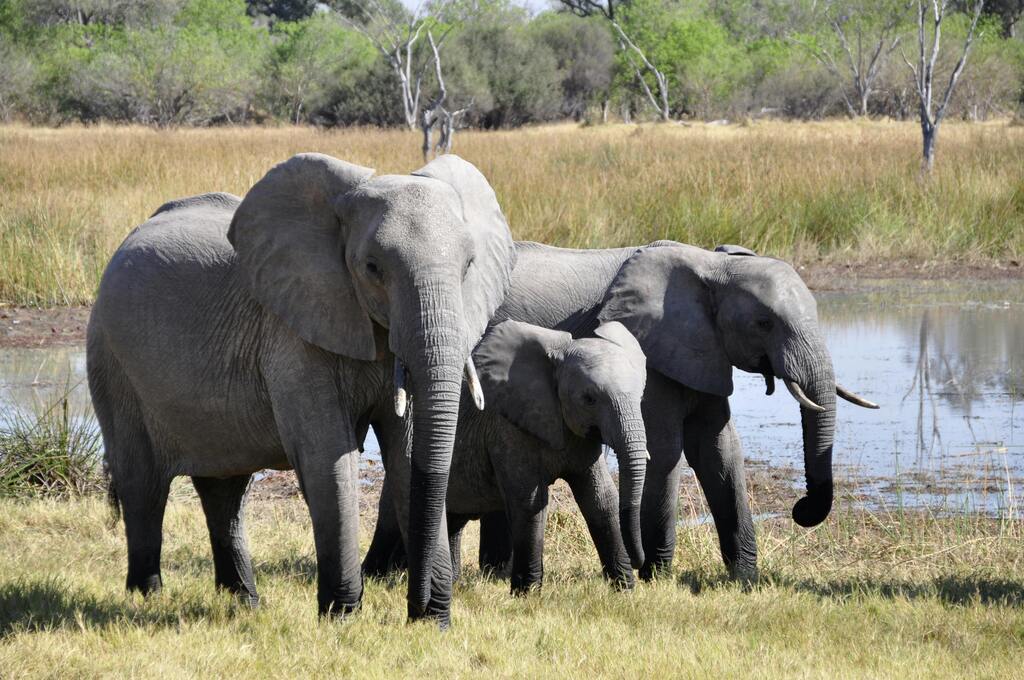
Triple group of elephants with baby elephant, at Mole National Park
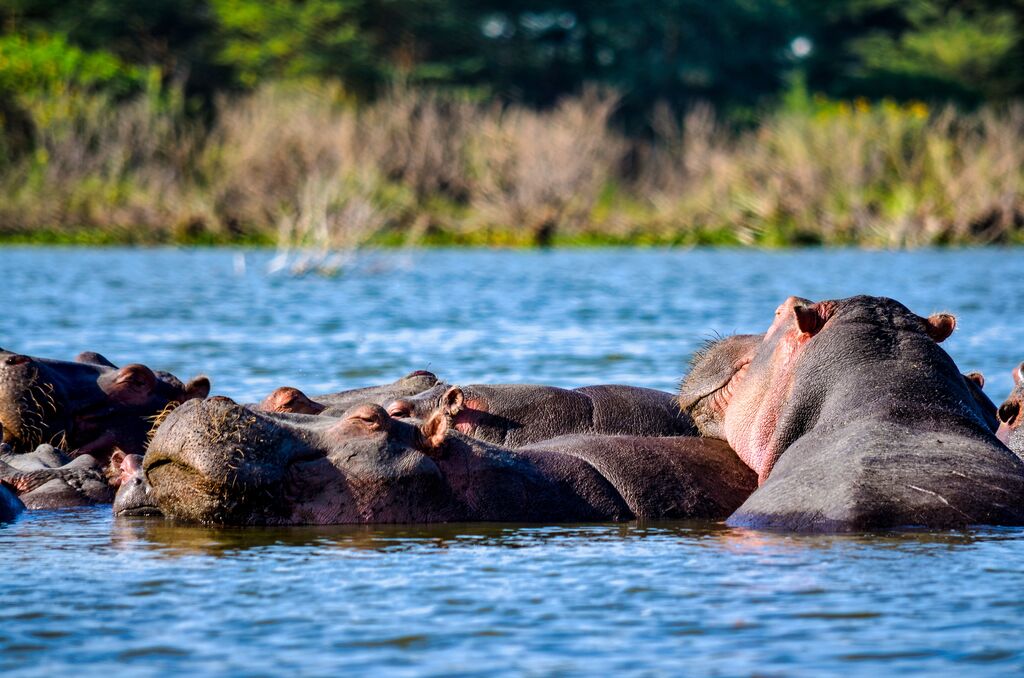
Hippos as seen....