🐊 Read Also: Wechiau Hippo Sanctuary or Mole National Park from Paga:
Which Is Easier to Reach?
Visitors exploring the fascinating border town of Paga often look for the next great wildlife adventure in northern Ghana. Two of the country's most popular nature destinations are the Wechiau Hippo Sanctuary and Mole National Park. Both offer unforgettable encounters with wildlife, but they differ significantly in travel logistics, facilities, and overall experience.
Savannah Region · Mole National Park · From the Upper East
From Paga to Mole
Ghana's largest protected area, where an armed ranger walks you on foot toward wild elephants. It is also a full travel day from Paga, not an afternoon — and knowing that before you plan is the difference between a good trip and a bad one.
The distance, honestly
Paga sits in the far north-eastern corner of Ghana, on the Burkina Faso border. Mole is in the Savannah Region, west-central in the northern belt, 24 km from Damongo and 146 km from Tamale.
These are not neighbours. The practical route runs Paga → Bolgatanga → Tamale → Damongo → Larabanga → the park gate, and you should budget a full travel day for it. There is a more direct western line through Tumu and Wa, but the roads are poor and it is slower in practice than going round.
What that means for planning
Mole is not a day trip from Paga and nothing you read should suggest otherwise. Treat it as a separate leg of a northern route, with at least two nights at the park — one is not enough, because your sightings depend on getting more than one safari in.
The sensible sequence
Fly Accra to Tamale. Do the Upper East first — Bolgatanga as your base, with Paga, Pikworo, Tongo Hills and Navrongo. Then come back down through Tamale and go west to Mole. Then out from Tamale again. That way you cross the country once rather than three times.
Getting to the gate
Public transport works: bus from Tamale to Damongo, then a tuk-tuk to the park. You can stop at Larabanga on the way and see the mosque. If you have a large bag, buy it its own seat.
Or hire
A vehicle with a driver from Tamale removes every logistical problem this journey has and is worth it if there are two or more of you. See our public transport page.
Why the pairing works anyway
Given all that, why put Paga and Mole in the same trip at all?
Because between them they show you the two halves of what the north actually is — and because you are already up here.
- Paga is the inhabited savanna. Farmed, walled, painted, worked by people for centuries. Crocodiles protected by an oath. Trees owned by lineages. A landscape that is entirely a human product.
- Mole is what the same country looks like without that. 4,500-odd square kilometres of savanna woodland with elephants in it. Same soil, same rainfall, same trees — no people.
- And the contrast is the education. Walk the Kassena parkland one week and Mole the next and you understand exactly how much of northern Ghana's landscape is a farming system rather than a wilderness. Most visitors never see both and assume the north is one thing.
There is also a plain practical argument. Flying to Tamale and going home again having seen only the Upper East wastes the hardest part of the journey, which is getting north in the first place.
What Mole actually is
Ghana's largest wildlife reserve and the first protected area the country established. Published figures for its size range from about 4,500 to 4,840 square kilometres depending on source — we give the range rather than pick one, because nobody seems to agree.
The landscape is riparian and savanna woodland, with a sharp escarpment marking the southern boundary. The accommodation sits on top of that escarpment, roughly 250 metres up, looking down over waterholes. That geography is the whole design of a visit here: you can sit on a terrace with a drink and watch what comes to drink below you.
The elephants
Mole protects the largest elephant population in Ghana, commonly given as around 600 — treat that as an estimate rather than a count. Herds of ten to thirty visit the waterholes below the escarpment, and larger groups are reported in the deeper zones.
Everything else
Kob antelope, roan antelope, warthog, baboon, green monkey, buffalo, hyena sign. Birding is genuinely strong — Abyssinian ground hornbill, white-backed vulture, saddle-billed stork along the seasonal rivers and dambos. Bring binoculars; most visitors do not and regret it.
Staying inside the park
There is one hotel within the park itself, on the escarpment with the waterhole view, offering everything from dormitory beds to family rooms — and a separate luxury lodge operates in the park for those who want it. Budget guesthouses are available at Larabanga, a short drive from the gate.
A word on facilities
This is a remote park in a region with real infrastructure constraints. Water supply interruptions are reported by visitors often enough to mention. Order meals ahead. None of this ruins a stay; arriving without expecting it might.
Walking with elephants
This is the thing Mole has that almost nowhere else does, and it is the reason to come.
The walking safari leaves at 6:30 in the morning, runs about three hours, and covers five to eight kilometres of flat ground led by an armed ranger. You walk into savanna woodland on foot, toward animals, at close range. There is no vehicle between you and what you are looking at.
In most of Africa's famous parks that is simply not permitted. Here it is the standard product, and it produces a completely different quality of encounter — you are in the landscape rather than driving through it, and you hear it.
The jeep alternative
Game drives cover vastly more ground and are the better bet for roan antelope, larger elephant groups and the deeper zones. They must be arranged at the park office the evening before — this catches people out, so ask on arrival.
Do both if you can
Walk in the morning, drive in the afternoon, and stay a second night so you have another morning. One safari is a lottery ticket; three is a reasonable expectation of seeing something.
What to wear
Neutral colours, closed shoes with grip, long trousers. Not white, not bright, and nothing that rustles.
Listen to the ranger
You will be on foot near wild elephants and buffalo. The ranger's instructions are not ceremonial and there is no argument to be had about them. Do exactly what you are told, immediately.
Honest expectations
Mole is regularly sold as Ghana's answer to an East African safari. It is not that, and going expecting it is the most common way visitors end up disappointed.
- Wildlife density is nowhere near Kruger, the Serengeti or the Mara. This is a large park with relatively few large animals in it. You will work for your sightings, and that is the honest description.
- You may not see elephants. Plenty of visitors do not. Reviews from people who stayed two nights and saw baboons, kob, warthogs and birds and no elephants are not unusual. If seeing an elephant is the entire point of your trip, build in enough time and accept the risk.
- The vegetation is dry bush, not lush. Beautiful in its own register, and not the green Africa of film.
- It is remote. The distance is real, the facilities are basic outside the luxury lodge, and there is no substitute for arriving in the right frame of mind.
What you get in exchange: a park where the wildlife is genuinely wild rather than habituated to a queue of vehicles, at a fraction of East African cost, where you walk rather than ride, and where you may well have the morning to yourself.
Larabanga, which you should not skip
Three to five kilometres from the park gate sits the village of Larabanga and one of the most significant buildings in West Africa.
The Larabanga Mosque is built in the Sudano-Sahelian style — whitewashed earth walls, conical towers, tapering wooden buttresses protruding from the fabric. It is commonly dated to the fifteenth century, which would make it the oldest mosque in Ghana and among the oldest in West Africa, and it sits on Ghana's UNESCO tentative list.
The construction technique is the detail worth carrying: mud, straw and shea butter — the same shea harvested by women from the parkland trees you walked past at Paga, used here as a binder and a weatherproofing agent in a building that has stood for centuries.
It is an active mosque
Not a monument. Visitors are welcome outside prayer times, and the community's elders have maintained guided access for heritage visitors for decades. Non-Muslims are generally not admitted inside. Dress modestly, ask before photographing, and pay the village guide properly.
The Mystic Stone
A large rock embedded at the village entrance, which local oral history ties to the founding of the mosque and the arrival of Islam in the northern territories. Ask your guide for the account — like most oral history in this region, it is told in several versions.
An old manuscript
A Quran manuscript is kept at the mosque and features in the guided account. Its age and provenance are matters of tradition rather than of established scholarship, and you should hear it as such — which takes nothing away from what it means locally.
Why it belongs on this page
Because it completes the argument. Paga shows you earth building as a family compound. Navrongo shows you earth building as a cathedral. Larabanga shows you earth building as a fifteenth-century mosque. One material, one region, three entirely different institutions.
When to go
December and January are the peak
The dry season concentrates animals at the remaining water, and this is when elephants come closest to the escarpment and the hotel. If elephants are the priority, come now.
February to April
Still dry and still good for sightings, but increasingly severe heat as the season runs out. March and April in the northern savanna are punishing.
Wet season, May to October
Green, dramatic, excellent birding, and much harder for game viewing — water is everywhere so animals disperse, vegetation is thick, and tracks deteriorate. Fewer visitors, which some people rate as a fair trade.
The practical answer
If you are combining Mole with the Upper East, late November through January gives you the best of both — elephants concentrated at Mole, and dry roads and cooler mornings in the north. Harmattan haze is the trade-off.
Practicalities
- Two nights minimum. One night buys you one or two safaris and a real chance of seeing very little.
- Book the jeep safari the evening before. Walking safaris are easier to join on the day.
- Binoculars. The single most useful thing you can bring and the one most people forget.
- Cash. Draw in Tamale. Do not rely on machines at Damongo or Larabanga.
- Order meals ahead at the park hotel — the kitchen is small and it makes a real difference to the wait.
- Neutral clothing, closed shoes, long trousers for walking safaris.
- Malaria precautions. Standard for the whole country, and worth saying on a page about sitting outside at dusk by a waterhole.
- Fees change and vary for Ghanaians and non-Ghanaians, and for walking versus driving. We do not publish figures — confirm at the park office.
Connected reading
- Mole.Ghana-Net.com — our dedicated Mole site: the park in full, the wildlife, the safaris and the lodges.
- Wechiau or Mole? — the honest comparison, if you only have time for one.
- National Parks & Protected Areas — where Mole sits among Ghana's twenty-one, and why three sites take almost all the visitors.
- Savannah walks and village tours — the same savanna, farmed instead of protected.
- Navrongo Cathedral — earth building as a cathedral, to set beside Larabanga's mosque.
- The Paga Crocodile Ponds — protection by taboo rather than by statute.
- Beyond the Pond — the Upper East, sorted by distance.
- Paga — the town in a day.
- Public Transport in Ghana — flights to Tamale, and getting west from there.
- Ghana-Net.com — the main portal. Publishing on Ghana since December 2000.
Practical details last verified . Mole National Park lies in the Savannah Region, 24 km from Damongo and 146 km from Tamale. Published figures for the park's area range between approximately 4,500 and 4,840 square kilometres across sources and are given here as a range. The elephant population is commonly cited at around 600 and should be read as an estimate rather than a census figure. Walking safari timing, duration and distance, and the requirement to book jeep safaris the previous evening, are from current visitor and operator accounts and are subject to change. The Larabanga Mosque is commonly dated to the fifteenth century and sits on Ghana's UNESCO tentative list; the age and provenance of the Quran manuscript held there are matters of local tradition. Fees, accommodation, transport and facilities change — confirm before travelling. All photography © Remo Kurka. Usage strictly by prior authorisation only.
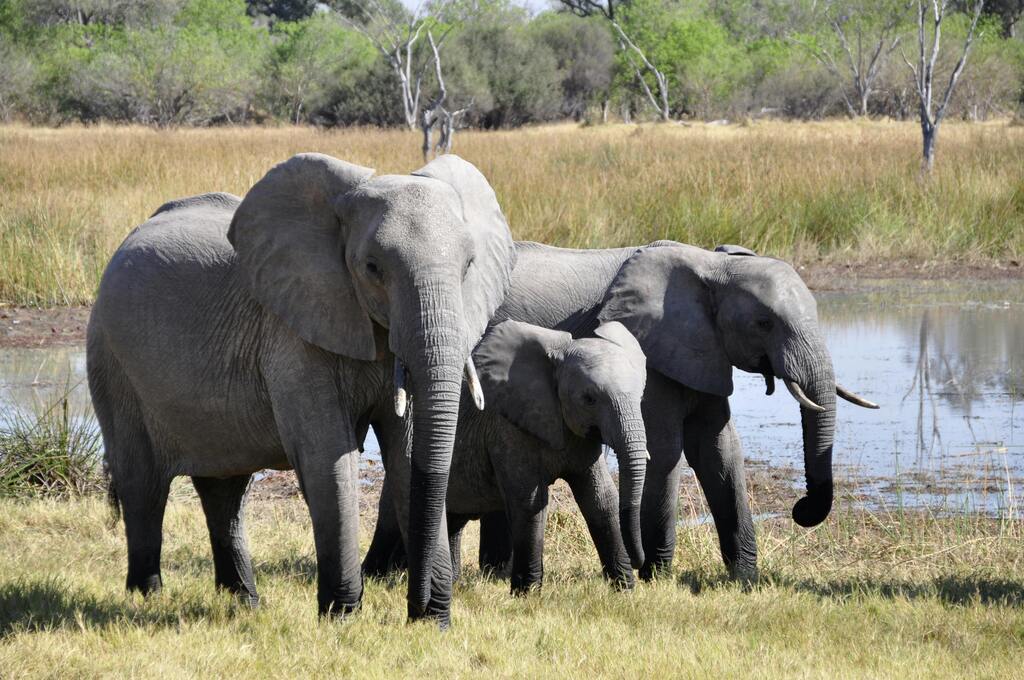
Triple group of elephants with baby elephant, at Mole National Park
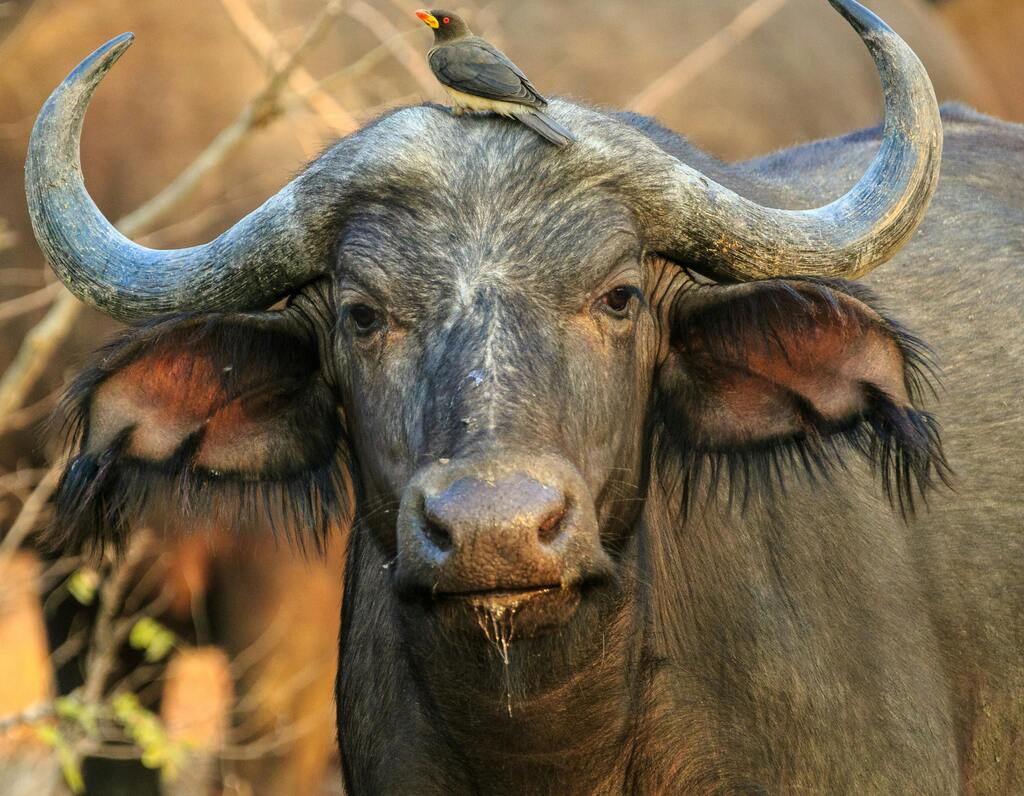
Buffalo at Mole National Nark