Savannah Region & Upper West · Kulmasa and Kaleo
Kulmasa & Kaleo
Two more sacred crocodile ponds, several hundred kilometres from Paga, holding the same relationship between people and animals with almost none of the traffic. At Kulmasa you do not sit on the crocodiles. That single difference is the reason to come here.
Where these actually are — and a correction
We have had this wrong on this site, and so has almost everyone else. Worth stating plainly before anything else.
Kulmasa
A rural town in the Sawla-Tuna-Kalba District of the Savannah Region, on the Wa–Kumasi highway, roughly 50 kilometres south of Wa. Not the Upper East. And, despite what most published sources say, not the Upper West either — the Savannah Region was created in 2019 out of the old Northern Region, and Kulmasa falls inside it. You will still see it filed under Wa West District, Upper West, in material that predates the reorganisation or copies from material that does.
Kaleo
A town in the Nadowli-Kaleo District of the Upper West Region, about 15 kilometres north of Wa. So Kulmasa and Kaleo are not in the same region as each other, and sit on opposite sides of Wa.
And neither is near Paga
An earlier version of our own Paga pages described these as "a short drive west of Paga." That was wrong. Paga is at the top of the Upper East on the Burkina border; Wa is in the far west. This is a several-hundred-kilometre journey across the top of the country, not a detour.
Why the confusion persists
Because Ghana redrew its regions in 2019, going from ten to sixteen, and a great deal of published tourism material has never been updated. If a page tells you Kulmasa is in the Upper West, it is working from pre-2019 geography — which also tells you how recently that page was actually checked.
Kulmasa
A dam-like body of water beside a rural town on a main highway, holding, by local and published accounts, over a hundred crocodiles. They are wild. They are not handled. There is no record of an attack on a resident or a visitor.
The founding legend
As at Paga, the town's existence and the animals' protection are the same story. The version most commonly told holds that the community's ancestor was a trader in the Waala Kingdom who faced persecution and fled. Coming to a river he could not cross, a crocodile surfaced and carried him across on its back. On the far bank he found the pond, and founded the settlement there.
A second version has the founder escaping from Burkina Faso the same way. The structural elements are constant: flight, water that cannot be crossed, a crocodile that carries a man to safety, and a settlement founded at the water in consequence.
This is the same shape as the Naveh tradition at Paga, several hundred kilometres east, and as the accounts at other sacred crocodile sites across the savanna. It is worth noticing that these are separate communities, different languages, different histories — telling structurally the same story about the same animal and the same problem, which is water.
The belief that is specific to Kulmasa
One element here does not appear at Paga, and it is the most striking thing local people tell visitors: the crocodiles warn the community of coming danger by leaving the pond and moving into the village to stay among the people.
Whatever you make of that as prediction, it describes something behaviourally real — crocodiles do leave water bodies, and in a landscape where the pond level is the community's most important signal, an animal abandoning it is information. The belief encodes attention to the thing that matters.
A frontier town
Kulmasa is not incidental to regional history. In the 1890s it marked the southern frontier of the Kingdom of Wala, as recorded in Ivor Wilks's standard study of Wa and the Wala. That places it on the edge of one of the significant pre-colonial polities of the northwest, in the same decades that Zarma and other raiders were moving through these lands.
How this differs from Paga — and why it matters
If you have read our page on the Paga ponds, you will know we set out the welfare argument there rather than pretending it does not exist: a wild animal called out of the water on demand, baited with food, and handled by strangers for photographs several times a day.
Kulmasa does not do that.
A visitor account published in 2025 describes it directly: the site is not touristic in the way Paga is, and you do not touch the crocodiles or pull them around by the tail. A chicken is bought and is genuinely sacrificed — the same mechanism for bringing the animals to the bank — and guides call them to the water's edge. But the encounter ends at watching and listening.
What you get instead
The same account describes a longer and richer visit than expected: two guides, extensive telling of how the village was founded, why people and crocodiles coexist, and the habits of the individual animals. Time rather than a photo opportunity.
How few people come
By that account, Kulmasa receives roughly a couple of visitors a month, with occasional larger tours. Paga receives thousands a year. You will very likely be the only outsider there.
The honest recommendation
If the handling at Paga is the part you were uneasy about — and a lot of visitors are — this is the alternative. Same tradition, same species, same protective taboo, without the part that made you uncomfortable.
And the honest caveat
Paga is organised, guided, signposted and reachable. Kulmasa is a village pond with two men who know how to call crocodiles. That is the appeal and the difficulty in the same sentence. Do not arrive expecting infrastructure.
Kaleo, and a note on what we do not know
Kaleo sits about 15 kilometres north of Wa in the Nadowli-Kaleo District, and its pond is routinely named alongside Kulmasa — and often alongside a third at Guree — as one of the sacred crocodile sites of the northwest. The crocodiles are held as totems by the community, and have been since the settlements were established.
Beyond that, we are not going to pad this section.
Reliable published information on Kaleo specifically is thin, and much of what circulates appears to be Kulmasa material with the name swapped, or generic copy that could describe any of the three ponds. We would rather tell you that than write four confident paragraphs out of nothing, which is what most pages covering these sites do.
If you have been to Kaleo or Guree — what the arrangement is, whether there are guides, whether handling happens, what the pond is like now — we would genuinely like to hear from you, and we will credit and publish corrections. Our contact details are on the main site.
The pond is in trouble, and it is worth knowing why
This is not a preserved site. It is an unprotected one, and the people who live beside it have said so publicly.
In 2021, residents of Kulmasa told local media that their crocodile pond was wasting away — that the site was declining in value and could cease to be of any tourism use at all if nothing was done. The president of the Kulmasa Youth Association appealed for investment to make it a viable attraction and generate revenue for the district.
A year earlier, a guide at the pond had raised a sharper worry. The crocodiles are not tamed, they have never hunted anyone, and the pond has no formal protection and no realistic policing. His fear was specific: that if the animals were habituated to people, neighbouring communities who do not hold the crocodile as a totem could kill them all.
Read that carefully
The protection at Kulmasa is a belief held by one community. It does not extend to the next village. There is no statutory designation, no warden and no boundary. A taboo protects the animals from the people who hold it, and from nobody else.
The tourism paradox, sharply
Kulmasa needs visitors to have any economic case for its pond. But the guide's fear is that the very habituation tourism brings would strip the animals of their wariness and leave them killable. Paga solved this by becoming famous enough that everybody has a stake. Kulmasa is in the dangerous middle.
There is a straightforward conclusion for a visitor. Go, pay properly, pay the guides directly, and do not push for the Paga experience. The thing that makes Kulmasa worth the journey is precisely the thing that would be lost if it became the same.
Visiting
- Arrange it in advance if you can. This is not a gated site with an office. Someone has to be found who can call the crocodiles. Ask at your accommodation in Wa, or through a Wa-based guide, rather than turning up cold.
- Cash only, in small notes. There is no card facility and no reason to expect one. Draw what you need in Wa.
- You will pay for a chicken and for the guiding, separately. Both are normal. The chicken is genuinely sacrificed, at the pond, to bring the animals to the bank.
- Pay the guides directly and well. Two men giving you an hour of their time and the founding history of their village, in a place that sees a couple of visitors a month, are not on a salary.
- Do not ask to touch or sit on the animals. It is not done here. Asking puts the guides in an awkward position and pushes the site toward the thing it currently is not.
- Early or late. Crocodiles bask when their temperature suits them, and the Savannah Region at midday is severe. There is minimal shade.
- Ask before photographing people, the sacrifice, or anything that looks ceremonial. Accept a no.
- Allow more time than you think. Accounts consistently describe the visit running longer and richer than expected, because the guides talk. That is the point of coming.
Getting there
Wa is the hub for both ponds, and the only sensible base. This is the far northwest of Ghana and it is a long way from everywhere.
To Wa
Scheduled domestic flights serve Wa from Accra, which is by far the most sensible way in — the alternative is a very long drive. See our public transport page for how domestic flights, coaches and trotros actually work.
Wa to Kulmasa
Roughly 50 kilometres south, on the Wa–Kumasi highway. Being on a main road rather than a track is the one logistical thing Kulmasa has going for it. Transport toward Sawla and Kumasi passes through.
Wa to Kaleo
About 15 kilometres north, on the road toward Nadowli. Close enough to be a short run out of Wa.
Combining sensibly
The northwest circuit is Wa, the Wechiau Hippo Sanctuary on the Black Volta, the Nakori Mosque, and these ponds. Paga and the Upper East are a separate trip across the top of the country — plan them as two legs, not as neighbours.
Connected reading
- The Paga Crocodile Ponds in full — the species, the safety record, and the welfare question these ponds answer differently.
- Guardians of the Ancestors — the founding oath at Paga, and the water scarcity underneath all these legends.
- The Kassena, and the Crocodiles — totemic animal protection as a system, not a curiosity.
- Wechiau or Mole? — the hippo sanctuary on the Black Volta, the other community-managed site of the northwest.
- Mole National Park — the elephants, and the anchor of any northern route.
- Beyond the Pond — everything within reach of Paga, sorted by distance.
- Paga — the town in a day.
- National Parks & Protected Areas — where taboo-protected sites sit alongside Ghana's twenty-one gazetted reserves.
- Ghana-Net.com — the main portal. Publishing on Ghana since December 2000.
Practical details last verified . Kulmasa is recorded in the Sawla-Tuna-Kalba District of the Savannah Region, created in the 2019 regional reorganisation; much published material still places it in the Upper West, reflecting pre-2019 boundaries. Kaleo is in the Nadowli-Kaleo District, Upper West Region. An earlier version of our own pages described these ponds as a short drive from Paga, which was incorrect and has been corrected. The founding legend and the belief that crocodiles leave the pond to warn of danger are recorded oral tradition. The account of the visitor experience, including the absence of handling, is drawn from a published first-hand visitor report from 2025. Residents' concerns about the pond's decline were reported in 2021, and the guide's concern about the absence of protection in 2020. Kulmasa's position on the southern frontier of the Kingdom of Wala in the 1890s is recorded in Ivor Wilks, Wa and the Wala (Cambridge University Press, 1988). Information on Kaleo and Guree specifically is limited, and we have said so rather than filling the gap. All photography © Remo Kurka. Usage strictly by prior authorisation only.
For the people of Kulmasa and Kaleo, crocodiles are not predators — they are protectors, ancestors, and sacred beings.
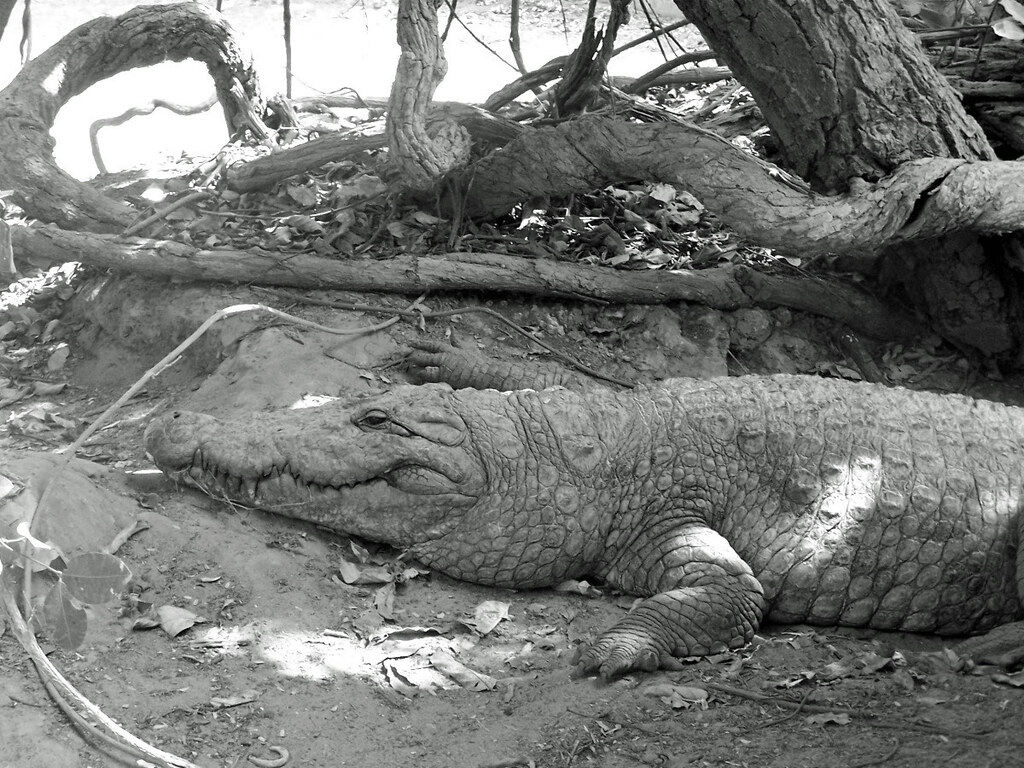
Kulmasa and Kaleo Crocodile Pond, Upper East Ghana (c) Remo Kurka