Upper East Region · Talensi District · Tongo-Tengzug
Tongo Hills & the Tengzug Shrine
A horseshoe of granite hills where balancing boulders whistle in the harmattan, and a cave shrine so powerful that the British stormed it twice and failed to close it. This is not a monument. It is a working oracle, and entering it has conditions.
Conditions of entry — read this before you go
Most pages about Tengzug mention this in passing or dress it up as a quirk. It is neither. It is the condition of admission to an active shrine, and you should decide about it at home rather than at the cave mouth.
To enter the inner cave shrine, you must be barefoot and bare from the waist up. This applies to men and to women, to visitors and to pilgrims, without exception.
Why
It is a requirement of the shrine, applied to everybody who enters, including Talensi people and including the traditional priests. It is not a test devised for tourists and it is not negotiable by paying more.
If you are not comfortable
Say so at the start, to your guide, before anyone climbs anywhere. There is a great deal to see without entering the inner shrine — the hills, the rock formations, the other shrines, the chief's palace, the village. Declining is a normal outcome and nobody will make it awkward.
What else to expect inside
Sacrifices are made here — chickens, birds, goats. The cave carries the smell of blood and of animals, and the floor is not clean. That is what an active shrine smells like. Visitors who arrive expecting a swept heritage interior are the ones who struggle.
Photography
Ask, every time, and expect refusals at the shrine itself. A refusal is the answer, not an opening position. Do not photograph the priest, sacrifices or consultations without explicit permission.
The landscape
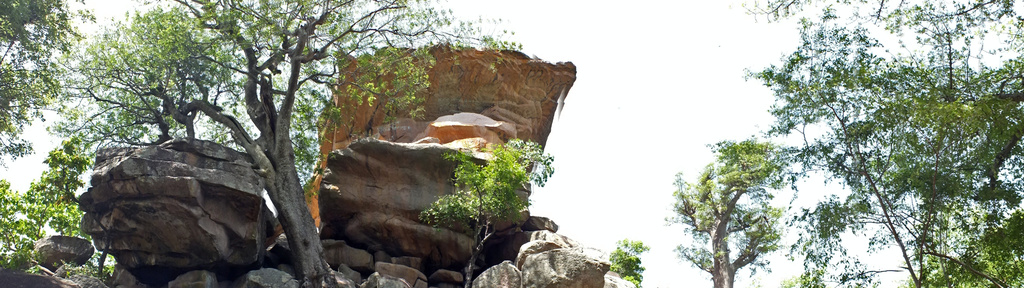
Tongo is a small town near Bolgatanga and the capital of the Talensi District. The cultural landscape around it consists of extraordinary balancing rock formations — granite stacked and poised — lying at and near the base of a horseshoe-shaped chain of hills, with Talensi shrines throughout.
The whistling rocks
Between December and February, the harmattan blowing through the rock formations produces a whistling sound across the hills. This is the one place in northern Ghana where harmattan improves the experience rather than ruining it — elsewhere the dust haze kills every view, here it is the reason to come in those months.
The caves
The Hiding Caves, where the chief took refuge and directed his forces against the British around 1911. The Hyena Caves, where the chief and other leaders met during that fighting. Also the Donkey Shrine and the Donkey Skull Cave, each with its own ritual meaning.
The architecture
The chief's palace is a complex of cylindrical earth houses joined by narrow alleyways, home to hundreds of people — one of the most striking pieces of vernacular architecture in Ghana, and a working residence rather than a display.
The status
Tongo-Tengzug sits on Ghana's UNESCO World Heritage tentative list and holds Ghana Tourism Authority regional awards from 2001 for cultural preservation and 2005 as visitor attraction of the year. It has not progressed to full World Heritage listing.
The shrine
The Talensi hold a supreme being, worshipped through lesser powers embodied in features of the landscape — rocks, boulders, cliffs, caves — and through constructed shrines. The system distinguishes earth shrines (tengban) from ancestral shrines (ba'ar).
The most significant is Ba'ar Tonna'ab Ya'nee, the cave shrine at Tengzug. A resident priest serves as oracle, and consultations for healing, guidance and misfortune go on continuously. Sacrifices are offered for good fortune and ancestral blessing.
Its reach is not local. Tonna'ab has drawn supplicants from far beyond Talensi country for well over a century — and among Asante traditionalists it is known and revered as Nana Tongo. That a shrine in the far northern savanna commands pilgrimage from the forest kingdom that once dominated the region is worth pausing over.
There is also a reason the hills held shrines and people in the first place. For centuries the Tongo Hills lay in a frontier belt between centralised states — the conquest kingdoms of Dagbon and Mamprugu to the south, the Mossi kingdoms to the north. The Talensi themselves were acephalous: settled cultivators with no paramount chief and no centralised authority. And through the 1880s and 1890s, the hills served as refuge for people fleeing the slave raiders working these lands.
The Gologo festival, also called Golib, is held annually between March and April, centred on the shrine and directed at the coming planting season. If you can time a visit for it, do — but arrange it well ahead and understand that you are attending a religious observance, not a display.
How the shrine travelled south
This is the part of Tengzug's history that almost never reaches a visitor, and it is remarkable.
Pilgrimage to the Tong Hills was arduous — days of travel from the forest zone and the coast. So the shrine was replicated. A man named Kobbina Assifu, from the Akyem area, was the first to carry the shadow of the shrine — yiehiyiŋ — south with him. He established a centre of ritual healing near Suhum, and it drew believers from across southern Ghana.
Supplicants no longer had to make the journey north. The shrine had come to them.
By 1931 the Gold Coast colonial government, alarmed at the growing number of adherents, began moves to ban Nana Tongo outright. Within months, J.B. Danquah — lawyer, scholar, and one of the founding figures of Ghanaian nationalism — intervened on Assifu's behalf.
Consider what that means. A shrine from an acephalous people in the far north, franchised into the forest zone by a private individual, banned by a colonial administration nervous of its reach, and defended by the man who would later propose the name Ghana for the independent nation.
Tonna'ab is not a curiosity in a hill village. It is woven into the political history of the country.
1911 and 1915: the hills that would not submit
The Tongo Hills were among the very last places in what became Ghana to come under British control, and the manner of it is on the record.
- 1911. A British military expedition stormed the hills to end Talensi resistance. The chief directed his forces from the caves. The resistance was broken, the Talensi were evicted from the hills, and all access to the sacred sites was banned.
- 1915. British officers discovered that people had been returning to the hills clandestinely and that the shrines had been reactivated. A second assault was mounted the same year.
- By the 1920s. People had returned in numbers, and Tonna'ab was flourishing again. The colonial administration had run out of ways to close it.
- 1931. Having failed to suppress the shrine in the north, the government moved instead against its southern offshoot — and was checked there too.
Two military expeditions, an eviction, a ban on access, and a second campaign four years later. The shrine outlasted all of it, and it is still operating.
One point of accuracy. You will occasionally read that the people hiding in these caves in 1911 were escaping capture as slaves by the British. Those are two separate histories run together. The hills genuinely were a refuge from slave raiders in the 1880s and 1890s — raiding that filled places like Pikworo, at the other end of the Upper East. The 1911 fighting was resistance to colonial conquest. Both are true; they are not the same event.
The most studied people in northern Ghana
In 1934, the social anthropologist Meyer Fortes began fieldwork among the Talensi. The books that came out of it became foundational texts of British social anthropology and are still taught. If you have ever encountered the Talensi in a university reading list, you encountered Fortes.
His material on kinship, ancestor worship and ritual practice is extraordinarily detailed — including the Talensi emphasis on firstborn children, and the principle that a person cannot become a revered ancestor without descendants to carry out the rituals after their death.
And the criticism, which is fair
Fortes worked in a functionalist tradition that paid comparatively little attention to material culture and almost none to history. Later scholars have argued that the result left the Talensi, in one memorable phrase, marooned on the margins in a timeless ethnographic present — described as though they had no past and no change.
Why that matters at the shrine
Because the history is the interesting part. A shrine that resisted two military campaigns, franchised itself to the forest zone, was targeted by colonial legislation and defended by a nationalist lawyer is not a people outside time. Later work — notably on the history of Tonna'ab itself — has set about correcting the picture.
Worth carrying with you: the most famous account of these people is also, by the assessment of later scholars, one of the reasons their history went untold for decades.
Visiting
- A guide is required, not optional. Arrange at the tourist office at Tongo. The guides are local, they know which shrines may be approached and which may not, and their fee and tips are the site's income.
- It is a climb. Rocky, uneven, and steep in places, with real scrambling to reach the shrine. Proper footwear, and be honest with yourself about your knees — you will also be doing part of it barefoot.
- Allow half a day. Three hours minimum for the walk, the shrine and the village. Longer if you want the caves and the rock formations properly.
- Cash only, in small notes. Draw in Bolgatanga. Expect separate charges for entry, guiding and photography, set locally and subject to change.
- Early morning. No shade on the rocks and the Upper East at midday is severe. Also the best light on the formations.
- December to February for the whistling — harmattan is what makes the rocks sound. Cooler too, though hazier for long views.
- Some things will be closed to you. Certain shrines are not open to outsiders, on some days nothing is, and if a consultation is in progress you wait. That is the correct answer and not a disappointment.
- You may be offered a consultation. Treat it as you would any religious rite in a tradition not your own — decline politely if it is not for you, and do not treat it as an attraction if it is.
Getting there
Tongo is a short run south-east of Bolgatanga, which is the base for this and for everything else in the Upper East.
From Bolgatanga
Shared taxis and trotros run to Tongo through the day. From Tongo you continue to Tengzug itself — arrange transport both ways, because there is no reason for a vehicle to be waiting when you come back down.
From Paga
Roughly an hour and a half via Bolgatanga. This is a separate half-day from the crocodile ponds and Pikworo rather than an add-on to them — see Beyond the Pond for how the district fits together.
From Tamale
Around three hours to Bolgatanga, then the short run out. Fly Accra–Tamale and hire locally rather than driving the length of the country — see our public transport page.
Private hire
Sensible here. The last stretch is rough, and having a vehicle waiting removes the one logistical problem this trip has.
Connected reading
- Beyond the Pond — everything in the Upper East, sorted by how far you have to go.
- Guardians of the Ancestors — the other living religious system in this district, at the crocodile ponds.
- Navrongo Cathedral — Catholicism layered over the same landscape, in earth and paint.
- Pikworo Slave Camp — the raiding these hills sheltered people from.
- The Kassena, and the Crocodiles — the neighbouring people, and the colonial habit of merging distinct groups.
- Savannah walks and village tours — earth architecture on foot.
- The Paga Crocodile Ponds — an hour and a half north.
- Paga — the town in a day.
- Ghana-Net.com — the main portal. Publishing on Ghana since December 2000.
Practical details last verified . The 1911 British military expedition, the eviction and ban on access, the second assault in 1915 and the shrine's revival by the 1920s are recorded in the colonial and historical literature. The transfer of the shrine's "shadow" south by Kobbina Assifu, the establishment of a healing centre near Suhum, the colonial government's 1931 moves against Nana Tongo and J.B. Danquah's intervention are documented in Ghana's UNESCO tentative-list submission for the site. Meyer Fortes began fieldwork among the Talensi in 1934; the criticism of his ahistorical treatment is that of later scholars including Allman and Parker. Tongo-Tengzug remains on the UNESCO tentative list and has not been inscribed. Entry requirements, fees, festival dates and guide arrangements are set locally and change — confirm before travelling. All photography © Remo Kurka. Usage strictly by prior authorisation only.
Rising from the savannah like the bones of the earth, these hills are more than geological wonders — they are the spiritual heart of the Talensi people, guardians of one of Ghana’s most revered sacred sites: the Tengzug Shrine.